Table of contents
Open Table of contents
- China Blocks Nvidia H200 AI Chips Despite US Export Approval
- AI Investment Bubble Warning: Trillions at Risk as Progress Could Stall
- Billion-Dollar AI Startup Founders Getting Younger, Average Age Drops to 29
- ChatGPT Preparing to Introduce Targeted Advertising for Free Users
- AI-Generated Singer Sienna Rose Sparks Authenticity Debate in Music Industry
- Brief Updates
China Blocks Nvidia H200 AI Chips Despite US Export Approval
Category: Regulation and Policy
Source: The Guardian
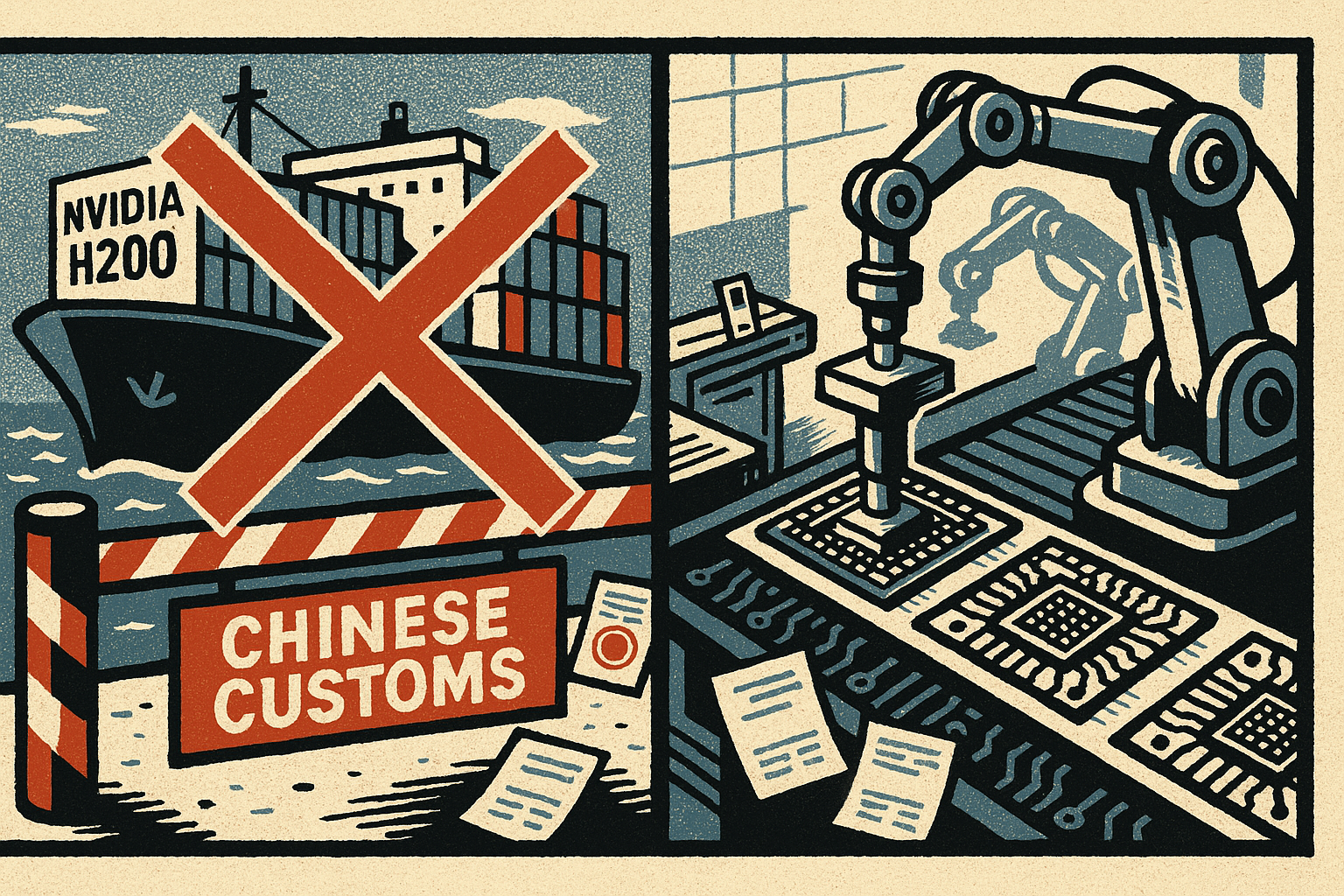
In a dramatic escalation of US-China tech tensions, Chinese customs officials have blocked shipments of Nvidia’s H200 AI processors from entering the country, despite the chips being approved for export by the US government. According to the Financial Times report, suppliers of H200 components have paused production amid the mounting confusion.
The situation is particularly complex given the unusual arrangement surrounding these chips. The Trump administration had cleared the H200—Nvidia’s second most powerful AI chip—for export to China, with the US government reportedly taking a share of profits. However, the process requires chips manufactured in Taiwan to first pass through US laboratories for testing, where a 25% tariff is imposed.
Nvidia had anticipated over one million orders from Chinese clients, with suppliers working around the clock to prepare for March shipments. Chinese government officials have also reportedly summoned domestic tech firms, warning them against purchasing the chips unless absolutely necessary, though no official reasons or formal ban have been announced.
Experts remain divided on the strategic implications of selling H200 chips to China. Proponents argue availability might slow China’s domestic chip development and maintain dependency on US technology, while opponents warn the chips are powerful enough for military weapons systems that could be deployed against the US or its allies.
AI Investment Bubble Warning: Trillions at Risk as Progress Could Stall
Category: Trends and Analysis
Source: The Guardian
Yoshua Bengio, one of the “godfathers” of modern AI, has issued a stark warning that the race toward artificial general intelligence (AGI) could hit an unexpected wall, potentially triggering a financial crash. With approximately $2.9 trillion projected to be spent on AI datacenters by 2028, and companies like Nvidia commanding over $4 trillion in market capitalization, the stakes have never been higher.
The investment scale is staggering: tech giants including Google, Microsoft, Amazon, Alphabet, and Meta are pouring billions into AI infrastructure, offering substantial bonuses to attract top engineers. Much of this expansion is fueled by private credit, creating potential contagion risks if AI development fails to meet expectations.
Bengio warns that if progress toward AGI stalls, it could burst the current valuation bubble, negatively impacting stock and debt markets with far-reaching consequences for pensions and investments. However, some analysts argue that current investment levels are justified by AI’s transformative potential, even without achieving full AGI.
The central concern is that AGI—a theoretical AI capable of performing any intellectual task a human can—remains the cornerstone of expected economic gains. If this promise doesn’t materialize as quickly as markets anticipate, the infrastructure buildup relying heavily on credit markets could face severe disruption.
Billion-Dollar AI Startup Founders Getting Younger, Average Age Drops to 29
Category: Trends and Analysis
Source: CNBC
The age profile of AI unicorn founders is shifting dramatically younger, with the average age dropping from 40 in 2021 to just 29 in 2024, according to a report by venture capital firm Antler analyzing 1,629 unicorns and 3,512 founders worldwide. This contrasts sharply with other industries, where the average unicorn founder age has risen from 30 in 2014 to 34 between 2022 and 2024.
Notable examples include Alexandr Wang, co-founder of Scale AI at age 29, who recently closed a $14.3 billion deal with Meta. Mercor, an AI-powered talent platform, was co-founded by three 22-year-olds: Brendan Foody, Adarsh Hiremath, and Surya Midha. AnySphere, an AI developer platform valued over $1 billion, is led by founders in their early twenties.
Fridtjof Berge, co-founder and chief business officer at Antler, explains that in the age of AI, being “quick, adaptable, and experimental” counts more than traditional corporate experience. The focus has shifted from long industry tenure to agility and a “move fast and break things” mindset, with recent training and education proving valuable for staying current with emerging technology.
The report also found that AI startups reach unicorn status faster than those in other sectors, averaging just 4.7 years to scale. Companies like Mistral, Lovable, and Suno AI exemplify this rapid growth trajectory. While early success often involves young founders, experts caution that leadership may evolve as companies mature.
ChatGPT Preparing to Introduce Targeted Advertising for Free Users
Category: Enterprise and Adoption
Source: TechPuts
OpenAI has confirmed plans to begin testing targeted advertisements within ChatGPT for users on the free tier and the low-cost Go subscription plan. The ads will appear in clearly marked sections at the bottom of chat conversations and are designed not to interrupt responses or alter how ChatGPT answers questions.
According to OpenAI, the ads will be subtly integrated as small sponsored suggestions related to discussion topics, clearly labeled as sponsored content and separated from ChatGPT’s answers. The company emphasizes that conversations will not be sold directly to advertisers, and users will have options to manage ad personalization or turn it off entirely. Sensitive topics such as health and politics will not be used for ad targeting, and ads will not be shown to minors.
The move comes as ChatGPT maintains hundreds of millions of weekly users worldwide, with the majority using the free version. Maintaining servers, research, and development costs billions annually, and advertising provides a way to support free access without raising subscription prices. Paid plans including Plus, Pro, Business, and Enterprise are expected to remain ad-free.
User reactions have been mixed, with some understanding the need for monetization to keep the service free, while others express concerns about potential influence on recommendations and privacy implications. The success of this change will depend heavily on how respectful and relevant the ads remain over time, with trust playing a crucial role in user acceptance.
AI-Generated Singer Sienna Rose Sparks Authenticity Debate in Music Industry
Category: Creative Technologies
Source: BBC
A mysterious singer named Sienna Rose, with nearly three million monthly Spotify listeners and trending songs in the Viral Top 50, has sparked widespread speculation that she may not be a real person but rather an AI-generated artist. Multiple indicators suggest computer generation, including Deezer flagging many of her albums as AI-created, complete absence of live performances or official videos, and a now-deactivated Instagram featuring homogeneous headshots with characteristic AI lighting.
Music analysis reveals telltale AI artifacts in tracks like “Into The Blue” and “Breathe Again,” including a persistent hiss throughout—a common feature of AI-generated music using apps like Suno and Udio. Experts note that errors introduced during AI software’s music layering leave unique “signatures” that make identification possible. Her prolific output of at least 45 tracks between September and December exceeds even notoriously productive artists like Prince.
The case highlights broader ethical and industry implications as the music world grapples with AI-generated content. Pop star Selena Gomez initially promoted one of Rose’s songs without knowing her suspected AI nature, later removing the post. In Sweden, a hit song by an AI-created artist was recently banned from charts after discovery, and some platforms like Bandcamp ban AI music outright.
Industry concerns center on AI music potentially flooding the market with cheaply produced content that competes with genuine artists, affecting royalties and livelihoods. Artists including Paul McCartney and Kate Bush have protested AI training on copyrighted works. The debate continues on balancing technological innovation with the integrity of human artistry, with stakeholders calling for transparency and respect for original work.
Brief Updates
Self-Deploying AI Agent Spends 6+ Hours Debugging VPS Deployment - A developer successfully had an AI coding agent autonomously deploy itself to a VPS over 6+ hours, handling nginx configuration, SSL setup, systemd services, DNS resolution, and permissions independently. The system uses Rust/Axam backend with systemd-nspawn for isolation, addressing API timeout limitations that typically kill complex operations after minutes. Reddit
Claude Cowork Safety Warning Issued - Users are being cautioned about potential data loss risks when using Claude Cowork, as the AI tool’s file deletion operations may be permanent. Best practices include creating dedicated sandbox folders, issuing precise commands, and carefully reviewing all proposed file operations before approval. Reddit
GE Vernova Positioned as Winner in AI Power Generation Push - Following President Trump’s directive for a $15 billion emergency power generation auction, analysts identify GE Vernova as the “clearest winner” to secure contracts for building new power plants to support AI infrastructure demands. CNBC
Debate on Single Neural Network Learning Limitations - A technical discussion explores why a single large neural network cannot effectively learn and understand billions of different individuals, citing catastrophic interference when updates from one person conflict with another. The analysis suggests true personalized AI would require fragmentation into many semi-independent models rather than one universal system. Reddit