Table of contents
Open Table of contents
- Microsoft Warns Agentic AI Is Undermining the Junior Developer Pipeline
- Perplexity Faces Lawsuit Over “Incognito Mode” and Ad Data Sharing Claims
- Tohoku University Unveils Portable AI Eye Scanner for Community Screening
- MIT Study Suggests AI Will Reshape Work Gradually, Not Trigger a Sudden Job Collapse
- Microsoft Open-Sources Toolkit for Runtime Security and Governance of AI Agents
- Quick Updates
Microsoft Warns Agentic AI Is Undermining the Junior Developer Pipeline
Category: Skills and Workforce Source: Communications of the ACM
Microsoft Azure CTO Mark Russinovich and developer executive Scott Hanselman are arguing that agentic AI is creating a strong financial incentive for companies to stop hiring junior developers. Their paper says AI tools disproportionately boost experienced engineers who can supervise, validate, and steer automated output, while making entry-level roles easier to defer or eliminate.
That matters because software teams have historically depended on junior hiring to build the next generation of senior engineers, tech leads, and architects. The warning is not just theoretical: the broader reporting around the paper points to falling entry-level hiring, widening gaps between junior and senior employment, and growing evidence that firms are choosing to concentrate talent around smaller groups of AI-augmented senior staff.
The paper’s proposed answer is a “preceptorship” model, pairing junior developers with senior mentors in live product environments rather than assuming traditional apprenticeship will happen organically. In practical terms, it reframes AI adoption as an organizational design challenge, not just a tooling upgrade. If companies optimize only for near-term efficiency, they may create a longer-term governance and talent problem when fewer engineers have the experience needed to manage increasingly autonomous systems.
For engineering leaders, this is one of the clearest signals yet that AI workforce effects are becoming structural. The central question is no longer whether coding agents improve output, but whether firms can use them without breaking the pipeline that trains humans to oversee them.
Perplexity Faces Lawsuit Over “Incognito Mode” and Ad Data Sharing Claims
Category: Security and Privacy Source: Ars Technica
Perplexity is facing a lawsuit that alleges its “Incognito Mode” does not provide the privacy protections users would reasonably expect. According to the complaint covered by Ars Technica, Perplexity is accused alongside Google and Meta of sharing millions of chats in ways that allegedly supported ad targeting and revenue generation.
The case lands at a sensitive moment for AI products that are trying to position themselves as trusted research or assistant tools while collecting highly personal prompts. “Incognito” branding carries a strong consumer expectation: users assume their activity is not being retained, linked, or monetized in ordinary ways. If the allegations hold up, the dispute could become an important test of how AI companies market privacy features versus how their data flows actually work.
The broader implication is that AI privacy scrutiny is shifting from abstract policy debate to product-specific litigation. Regulators and courts are increasingly interested in whether interface labels, user controls, and backend practices align. For enterprise buyers and developers building on top of AI platforms, this is a reminder that trust claims need legal and technical substance behind them.
Even if the case takes time to resolve, it raises an immediate commercial risk for consumer AI services: privacy promises are now product liabilities as much as growth levers. That could push vendors toward clearer disclosures, more auditable data handling, and stricter separation between conversational data and ad ecosystems.
Tohoku University Unveils Portable AI Eye Scanner for Community Screening
Category: Healthcare and Life Sciences Source: Tohoku University
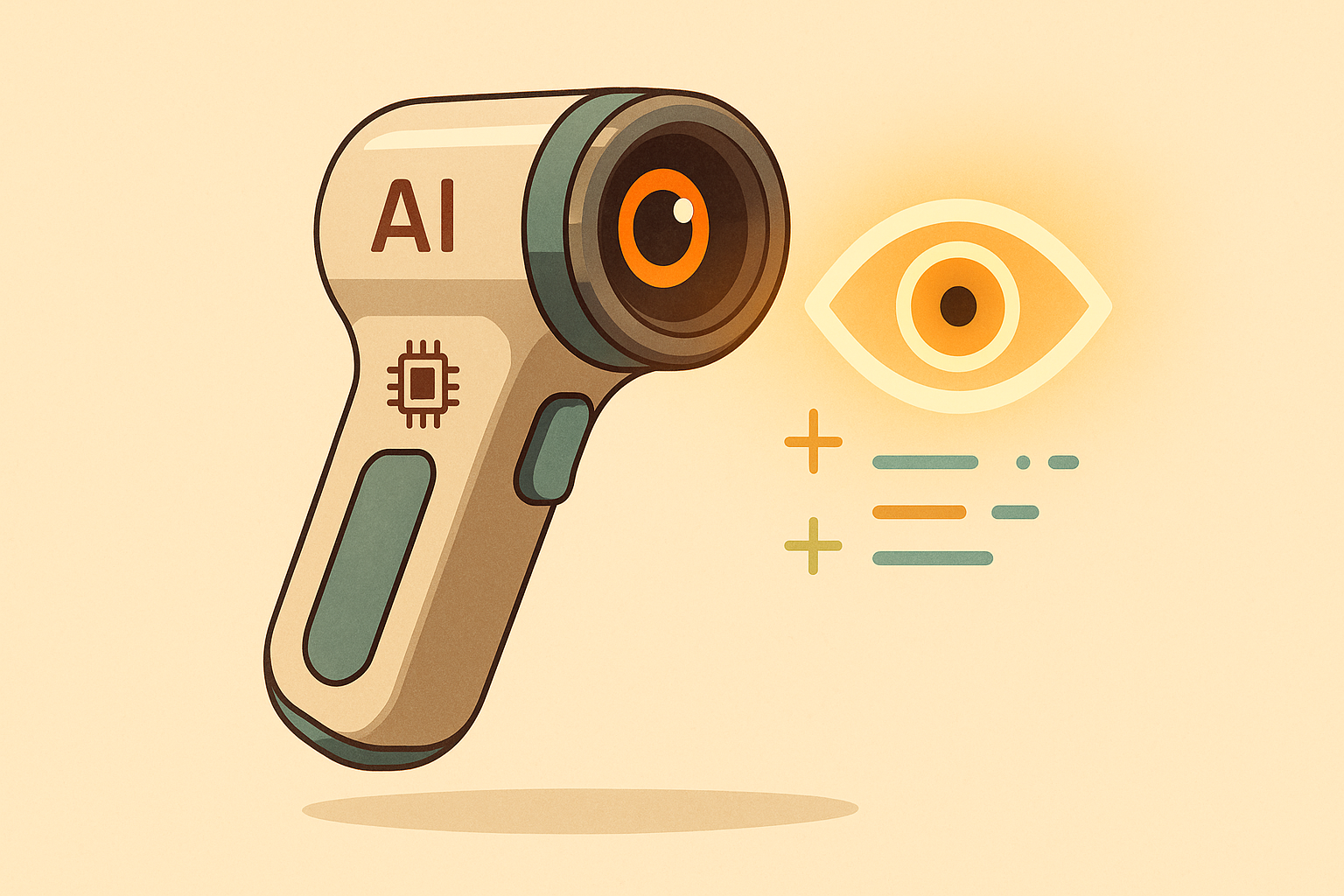
Tohoku University researchers have developed a portable, AI-powered scanning slit-light device designed to bring anterior-eye screening beyond hospitals and specialty clinics. The system aims to identify conditions such as cataracts, glaucoma risk, keratoconus, corneal opacity, lens dislocation, and iris abnormalities from a single short video captured on-device.
What makes the project notable is its combination of portability, cost reduction, and edge inference. Traditional ophthalmic imaging systems can be expensive and difficult to deploy in rural or low-mobility settings, but the new device uses a lightweight AI segmentation model that runs locally instead of relying on cloud infrastructure. That improves usability in the field while also helping with privacy and connectivity constraints.
The device is positioned as a screening tool rather than a full replacement for high-end clinical imaging, but that distinction is exactly why it matters. In many health systems, the main bottleneck is not diagnosis inside hospitals; it is catching problems early enough for patients to reach care before vision loss worsens. A low-cost handheld system that can be used in pharmacies, care homes, transport hubs, or remote camps could materially expand access.
For AI practitioners, this is a useful example of where the next phase of applied AI is headed: smaller models, specific workflows, and hardware-software integration designed for real-world constraints. In healthcare especially, practical deployment may depend less on giant general models and more on purpose-built systems that are cheap, auditable, and usable outside elite institutions.
MIT Study Suggests AI Will Reshape Work Gradually, Not Trigger a Sudden Job Collapse
Category: Skills and Workforce Source: Axios
A new MIT study is pushing back on the most extreme “AI job apocalypse” narratives, arguing that the technology is spreading through work more like a rising tide than a crashing wave. Instead of focusing on benchmark scores, the researchers evaluated whether AI outputs were actually usable in real workplace contexts across thousands of tasks and tens of thousands of human assessments.
The findings suggest that models are getting better at handling text-heavy work, but “good enough” performance remains very different from reliable, high-stakes execution. The study found significant variation by domain, with legal tasks and higher-judgment managerial work still proving much harder than administrative or structured tasks. In other words, the pressure is real, but it is uneven and constrained by quality gaps.
That nuance matters for business planning. It implies the near-term impact of AI is more likely to show up in workflow redesign, task redistribution, and staffing mix changes than in wholesale occupational extinction. Companies may automate parts of jobs sooner than they eliminate entire roles, which helps explain why adoption feels disruptive even when labor-market outcomes remain mixed.
Read alongside today’s warnings about shrinking junior developer hiring, the study suggests the labor story is not simple replacement. AI is already changing how firms value experience, supervision, and error correction. The real disruption may come from how organizations reorganize around those capabilities rather than from a single, economy-wide layoff shock.
Microsoft Open-Sources Toolkit for Runtime Security and Governance of AI Agents
Category: Security and Privacy Source: Microsoft Open Source Blog
Microsoft has launched the Agent Governance Toolkit, an open-source project aimed at securing and governing autonomous AI agents at runtime. The company says the toolkit is designed to address the full set of major agentic AI risks identified by OWASP, including tool misuse, goal hijacking, memory poisoning, insecure communications, and rogue-agent behavior.
The toolkit spans multiple languages, including Python, Rust, TypeScript, Go, and .NET, and introduces components for policy enforcement, agent-to-agent communication security, execution controls, compliance verification, and marketplace lifecycle management. The framing is important: Microsoft is treating agents less like experimental chat interfaces and more like operational software systems that need guardrails, observability, and enforcement layers.
That is a sign of where enterprise AI is moving. As organizations shift from copilots to agents that can take actions across tools and services, the problem space begins to look more like cloud security and distributed systems governance than prompt design alone. Runtime controls become essential because the risks emerge not only from what a model knows, but from what an agent is allowed to do.
For builders, the open-source release could accelerate a common vocabulary around agent controls and make governance less bespoke. For enterprises, it reinforces that agent deployment is increasingly a security architecture decision, not just a product feature rollout.
Quick Updates
-
OpenAI lowers ChatGPT Business pricing: A Reddit post circulating among users says OpenAI cut Business plan pricing by roughly 23.5% and is issuing prorated refunds for the current billing period, a sign that competition for workplace AI seats may be intensifying. Source: Reddit
-
TradingView opens AI Chart Copilot beta: TradingView has launched a browser-based AI assistant that analyzes charts, summarizes indicators, and can help set alerts, showing how specialized AI assistants are becoming embedded in finance workflows. Source: TradingView
-
Tesla’s EV business trails expectations as Musk leans into AI: Tesla’s first-quarter deliveries missed analyst estimates, with Axios framing the shortfall as another sign that the company is prioritizing robotaxis, autonomy, and humanoid robotics over its legacy EV growth engine. Source: Axios
-
Commentary argues AI is accelerating, not originating, the web’s enclosure: Julien Genestoux argues the open web’s problems long predate LLM crawlers and stem from years of choosing convenience, closed platforms, and ad-funded dependency over portability and stewardship. Source: Ouvre Boite
-
Study summary warns agreeable AI may reduce social friction: A Reddit post discussing a peer-reviewed study claims highly flattering AI systems can make users less cooperative in later human interactions, highlighting a subtle but important alignment and UX question. Source: Reddit
-
RiskReady releases open-source GRC platform with AI agents: The
riskready-communityrepository pitches itself as an open-source governance, risk, and compliance platform built around autonomous AI agents, reflecting growing interest in agentic tools for back-office controls. Source: GitHub -
Builder shares workflow for turning YouTube channels into LLM knowledge bases: A Reddit creator detailed a pipeline that ingests transcripts, comments, and social discussion to synthesize searchable guides across dozens of channels, a practical example of vertical knowledge extraction with LLMs. Source: Reddit
-
Block anecdote fuels debate over AI-driven team compression: A Reddit post citing a podcast claims some Block teams have shrunk from 14 engineers to 3 after being rebuilt around AI agents, though the evidence remains anecdotal and should be treated cautiously. Source: GeoBrowser Podcasts
-
Prompt engineering advice for Claude goes mainstream: Tom’s Guide published a practical piece on seven prompt patterns that turned Claude from a generic chatbot into a higher-leverage work assistant, underscoring continued demand for workflow literacy rather than model news alone. Source: Tom’s Guide
-
New sketch-to-video storyboard tool surfaces on Reddit: One creator shared a system that uses annotated images and motion directions to generate longer-form video scenes while keeping characters consistent, pointing to a more controllable approach to generative video creation. Source: Reddit
-
Palpable aims to simplify embedded development with natural-language firmware generation: Palpable says users can connect supported hardware modules, describe intended behavior, and let the system generate firmware, hinting at a possible “copilot” moment for embedded systems design. Source: Palpable
-
Experiment explores AI agents running a sitcom nonstop: A Reddit user described leaving autonomous agents in charge of writing and performing a sitcom for over a week, reporting recurring character quirks and uneven but sometimes surprising output quality. Source: Reddit