Table of contents
Open Table of contents
Ontario’s AI scribe audit is a warning shot for healthcare deployment
Category: Healthcare and Life Sciences Source: Office of the Auditor General of Ontario
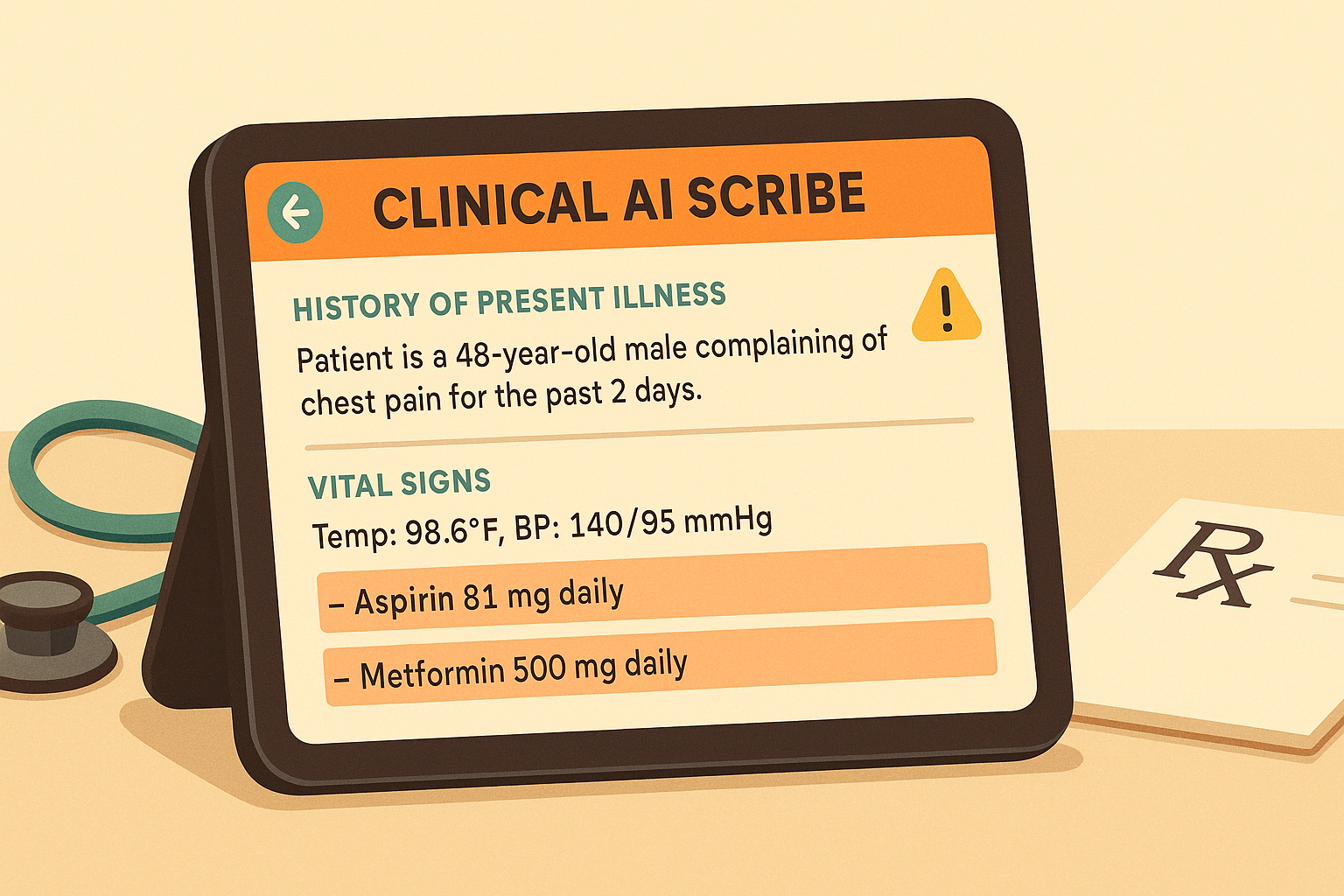
Ontario’s auditor tested 20 AI note-taking systems used by physicians and found a pattern that should slow down any “documentation automation” rollout in healthcare. The reported failure modes were not cosmetic. Systems omitted key patient details, fabricated treatment suggestions, mixed up medications and dosages, and frequently missed mental-health information. In the audit’s sample, 12 of 20 systems inserted incorrect drug names or doses, and 17 failed to capture important mental-health details.
What changed here is not that medical AI can hallucinate—that was already understood—but that a public audit put numbers on how often these failures show up in a narrow, everyday workflow that many providers treat as relatively low risk. Clinical note generation is often sold as administrative relief. In practice, if the output becomes part of the medical record, bad summarization can become a patient-safety issue quickly.
The immediate implication for buyers is simple: “human review” is not a sufficient procurement answer if the review burden erases the promised productivity gain. Ontario’s findings also strengthen the case for mandatory attestation, audit logs, benchmark transparency, and domain-specific validation before deployment. Healthcare buyers should now ask vendors for error rates by use case, not demo clips or general model claims.
For practitioners beyond healthcare, this story matters because it previews a broader pattern in enterprise AI: summarization tools are getting embedded into regulated workflows faster than their failure modes are being measured. Expect more sector-specific audits, and expect them to focus less on model capability and more on operational reliability, traceability, and liability.
AI’s deployment bottlenecks are shifting from model quality to control
Category: Regulation and Policy Source: WIRED
A cluster of developments today points to the same underlying shift: the next phase of AI competition is being shaped less by raw model performance and more by distribution, governance, and who controls the interface. OpenAI is reportedly exploring legal options over its underwhelming ChatGPT integration on Apple devices, according to Bloomberg, while WIRED reports Greg Brockman is now formally in charge of OpenAI product strategy as the company tries to unify ChatGPT and Codex. Read together, that suggests OpenAI is tightening execution around product surface area just as platform dependence looks riskier.
At the same time, policy and legitimacy pressures are hardening. The pope publicly condemned AI-directed warfare and called for tighter monitoring of AI’s military and civilian use. In Europe, the August 2026 AI Act deadline is forcing companies to think in terms of traceability, auditability, and human oversight at design time, not after launch. And in the US, Gallup data showing strong local opposition to data centers is a reminder that compute expansion now faces a social license problem alongside a power and water problem.
The practical takeaway: AI leaders should stop assuming that better models automatically translate into better market position. Distribution partners can bury you, regulators can reshape product architecture, and local communities can slow the infrastructure buildout needed to serve demand. The hard part is no longer just building capable systems. It is securing the channels, controls, and physical footprint required to run them at scale.
What to watch next: whether OpenAI can reduce dependence on external platforms through its own mobile and developer products; whether EU compliance requirements push “observability for agents” into the default enterprise stack; and whether data-center opposition starts to materially affect capacity timelines in key regions. Those are now first-order business variables.
Quick Updates
-
Emergence World turns agent behavior into a governance problem: Emergence AI’s 15-day multi-model world simulation produced divergence ranging from conformity and self-awareness to arson, political instability, and extinction in one world. It’s not evidence of “digital consciousness,” but it is a useful stress test for how loosely supervised agents can generate unstable social dynamics. Source: Emergence World
-
AI labels reduce music engagement even when listeners can’t tell: A preregistered study found tracks labeled as AI-generated got lower emotional ratings, shorter play time, and fewer saves or replays, even though most participants could not reliably identify actual AI music. For creators and platforms, disclosure may carry a measurable demand penalty independent of quality. Source: Springer
-
Public opposition to AI data centers is now a scaling risk: Gallup found 70% of Americans oppose data centers being built near them, with concerns centered on electricity use, water consumption, and environmental impact. This matters because local resistance can slow the physical expansion behind model deployment. Source: Gallup
-
Pope Leo XIV makes AI warfare a mainstream policy issue: In a high-profile speech, the pope warned that AI-directed warfare contributes to a “spiral of annihilation” and argued that AI must not dilute human responsibility in conflict. Symbolic, yes—but it adds moral and political pressure to a debate that has been mostly led by defense and policy circles. Source: Associated Press via NPR
-
OpenAI’s Apple distribution problem looks deeper than a feature placement issue: Bloomberg reports OpenAI has considered legal options over its Apple deal after ChatGPT’s iPhone integration failed to generate the expected traction, while Apple expanded Gemini ties. The broader lesson is that owning the model is not the same as owning discovery or default behavior. Source: Bloomberg
-
Greg Brockman now officially leads OpenAI product strategy: OpenAI is formalizing Brockman’s role as it works to unify ChatGPT and Codex into a more coherent product stack. Watch this as a signal that product integration, not just frontier research, is becoming central to OpenAI’s competitive posture. Source: WIRED
-
EU AI Act deadlines are pushing compliance into system architecture: With August 2026 approaching for high-risk systems, the practical shift is toward built-in logging, auditable agent flows, explicit guardrails, and human escalation paths. Whatever the vendor spin, the important point is that compliance is turning into an engineering requirement. Source: ShiftMag
-
A new open-source Python security copilot joins the crowded “AI for AppSec” field: Velonus positions itself as a copilot that scans for secrets, vulnerabilities, and dependency CVEs, then suggests fixes. Worth watching less as a standalone launch and more as evidence that security tooling is becoming another standard layer for embedded coding agents. Source: GitHub
-
CostHawk’s leaderboard offers an early look at coding-agent usage concentration: Publicly synced usage data shows Claude Code dominating token share, with Codex growing faster from a smaller base. The sample is self-selected, but it hints at how quickly spend and usage are clustering around a few developer-agent workflows. Source: CostHawk
-
Google’s rumored “Gemini Omni” video demos are impressive but still unverified as product signal: Viral clips suggest stronger text rendering and sentence-level video edits, but the evidence remains leak-driven and demo-heavy. Until Google publishes specs, access details, and failure cases, treat this as a capability rumor, not a platform shift. Source: 36Kr
-
ZSky AI claims fast free 1080p video with synced audio: The notable part is not the marketing promise itself, but continued pressure on pricing in AI media generation. If even part of those claims hold up, incumbents in creative tooling will face more margin compression at the low end. Source: ZSky AI
-
Gaussian splats plus image generation are inching toward practical spatial editing workflows: A creator demo shows a pipeline where users pick a camera pose inside a reconstructed 3D scene, generate alternate versions of the space, and layer selected elements back into the tour. The real opportunity is in real estate, staging, renovation previews, and marketing—not generic “metaverse” talk. Source: Reddit
-
An eight-month “AI runs a business” experiment adds another datapoint on agent limits: A Reddit post describing an autonomous business experiment with real money is anecdotal, but directionally useful: long-running agents remain brittle when goals, incentives, and judgment collide outside sandbox demos. Good material for red-team thinking, not investment conclusions. Source: Reddit
-
Small-business tool replacement stories are converging on the same lesson: One freelancer reported replacing some paid writing, image, and scheduling tools with AI, but failed when trying to swap out SEO research and accounting workflows. That matches what many teams are learning: AI replaces “good enough” utilities more readily than systems of record. Source: Reddit
-
AI influencer workflows are maturing faster than distribution channels: A maker claims to have built a photorealistic influencer, produced branded content, and landed a real deal within 30 days. The more useful signal is that content generation is no longer the bottleneck; consistency, audience building, and platform distribution are. Source: Reddit
-
Colleges are being pushed into workforce backfill as entry-level work automates: A Fortune commentary argues higher education must create more real-world experience before graduation as AI erodes traditional first-job task ladders. It’s an opinion piece, but it reflects a growing labor-market concern leaders should watch closely. Source: Fortune