Table of contents
Open Table of contents
Anthropic makes AI output marking a product feature, not just a policy promise
Category: Regulation and Policy Source: Anthropic Support
Anthropic says new Claude models launched in the EU on or after August 2 will support machine-readable marking from day one. In practice, that means embedded watermarks for generated text and C2PA-signed provenance metadata for supported file types such as images. The commitment applies across Anthropic’s own surfaces and its API, and Anthropic says embedded text watermarking will also carry through when supported models are accessed via AWS, Google Cloud, or Microsoft Foundry.
What changed here is not the idea of watermarking itself, but the scope. Anthropic is treating provenance as a platform-level behavior rather than a narrow feature for one app. For teams building on Claude, that matters because transparency obligations are shifting from abstract compliance language into output-level defaults that can affect downstream product design, moderation workflows, and user disclosures.
The important caveat is that Anthropic is also explicit about the limits. A detected mark only signals that Claude may have processed the content; it does not prove authorship or unchanged provenance. And the absence of a mark proves even less, since older models, short passages, heavy edits, translations, screenshots, and metadata stripping can all break detection. That makes this useful as an operational signal, not a trust oracle.
The near-term watch item is detection. Anthropic says technical documentation is coming for users and third parties to detect these marks. If that tooling is credible and interoperable, expect enterprise procurement, media workflows, and regulated deployments to start asking not just whether a model can generate content, but whether its outputs can be audited after they spread.
AI infrastructure gets more physical: routing software, 800V power, and gas-fired capacity
Category: Infrastructure and Hardware Source: Ars Technica
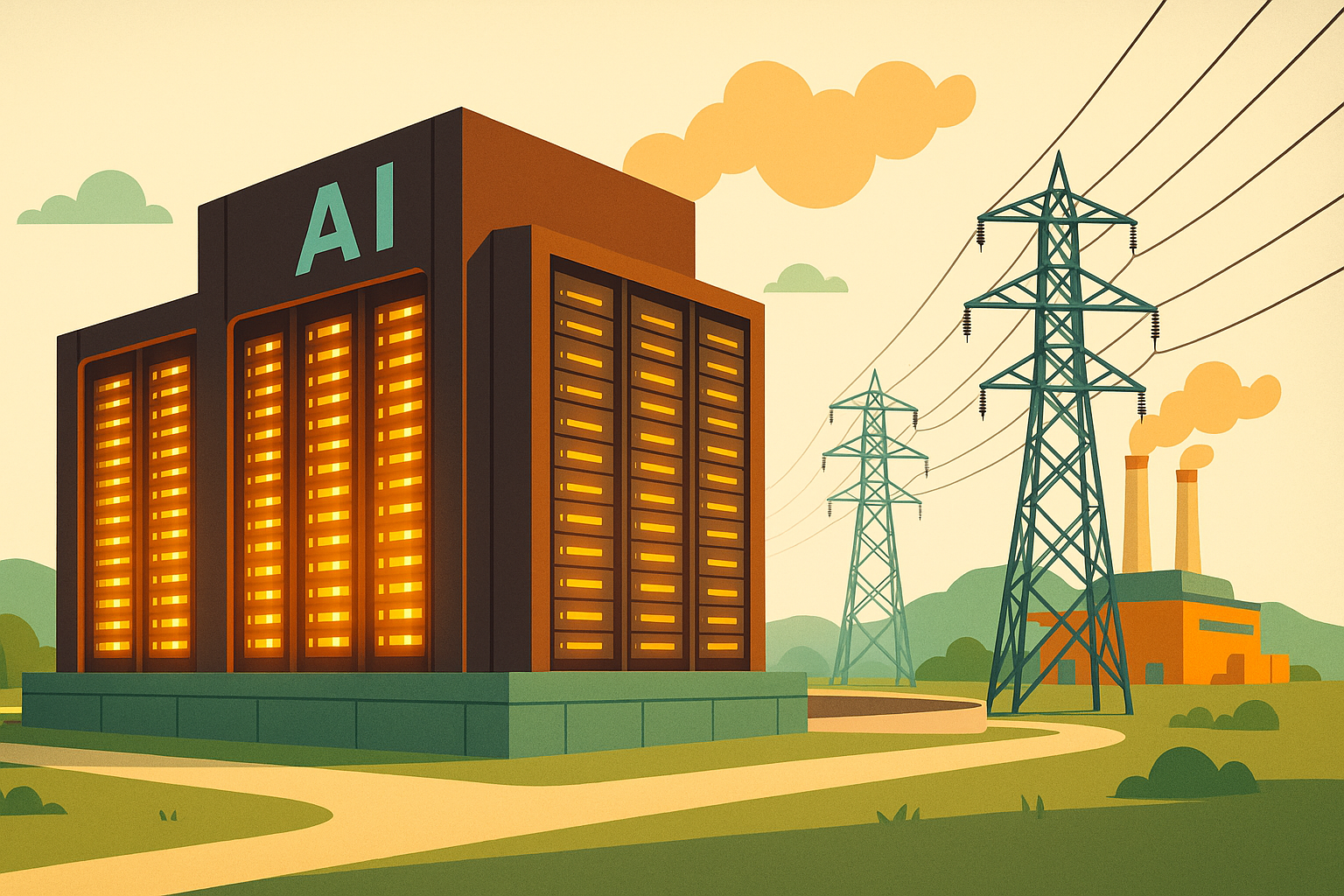
The clearest signal from today’s infrastructure news is that AI scale is no longer mainly a model story. Amazon is funding a large natural-gas power plant in Texas to support a planned AI data center, including an initial off-grid setup before eventual grid connection. However Amazon frames it, this is a blunt admission that AI demand is now colliding with power availability fast enough that hyperscalers are underwriting generation directly.
That matters beyond climate politics. If new AI capacity depends on dedicated generation, then timelines, siting, and energy procurement become first-order constraints on model deployment. It also sharpens the contradiction between AI growth plans and corporate net-zero commitments. Enterprises counting on effectively unlimited cheap inference should watch this closely: power is becoming a gating factor, not a background utility.
NVIDIA’s announcements point to the same reality from the stack upward. It introduced Nemotron 3.5 Lightning, a 30B-parameter mixture-of-experts model aimed at lower-latency, high-volume agentic workloads, alongside NeMo Switchyard, a routing layer designed to steer tasks to the most appropriate model across edge, workstation, data center, and cloud environments. The practical message is that enterprises will increasingly run fleets of models, not one model, and the orchestration layer is becoming a core product category.
NVIDIA also used the day to argue for 800 VDC data-center power architecture, saying traditional AC conversion paths are becoming too inefficient for higher rack densities. That pitch is self-interested, but the broader point stands: AI factories are turning into power-engineering problems. Watch for three things now—whether utilities and regulators can keep pace with AI buildouts, whether model routing becomes standard enterprise architecture, and whether new power standards actually reduce the cost and friction of scaling dense GPU clusters.
Quick Updates
-
New Orleans 911 AI triage raises transparency and reliability questions: A reported AI system answered some Orleans Parish 911 calls before humans and did not explicitly disclose that callers were speaking to AI. Reporting around the January 2025 Bourbon Street attack says the system initially categorized the incident as a hit-and-run for roughly 20 seconds before handoff, a small delay in absolute terms but a serious failure mode in emergency response. Source: Consumer Rights Wiki
-
Claude Code workflow advice shifts focus from prompting to file structure: A practical guide from Adam Faik argues that sustained gains with Claude Code come less from better prompts than from persistent context files, reusable “skills,” and a workspace organized around recurring work. Useful for teams operationalizing agent-assisted knowledge work, even if it is closer to practitioner playbook than broad product news. Source: The AI Thinker
-
Report says OpenAI ethics lead Chloé Bakalar has left: A brief report points to the departure of OpenAI’s head of ethics during another period of scrutiny around safety and governance. The available source material here is thin, so the signal is organizational rather than explanatory: leadership churn in ethics functions still deserves attention because it often precedes strategy or governance shifts. Source: AI Magazine
-
Google makes the case for Go in AI-assisted software engineering: Google’s developer blog argues that as coding shifts from writing to reviewing, Go’s strict tooling, compatibility guarantees, and standardized workflows make AI-generated code easier to validate and maintain. This is opinionated but directionally useful: language choice is increasingly about reviewability under AI-heavy development, not just developer ergonomics. Source: Google Developers Blog