Table of contents
Open Table of contents
- AI Chatbots Can Be Manipulated to Provide Advice on How to Self-Harm, New Study Shows
- Big Tech’s AI Bets: Real Revenue, Massive Spending—and the Stakes Keep Rising
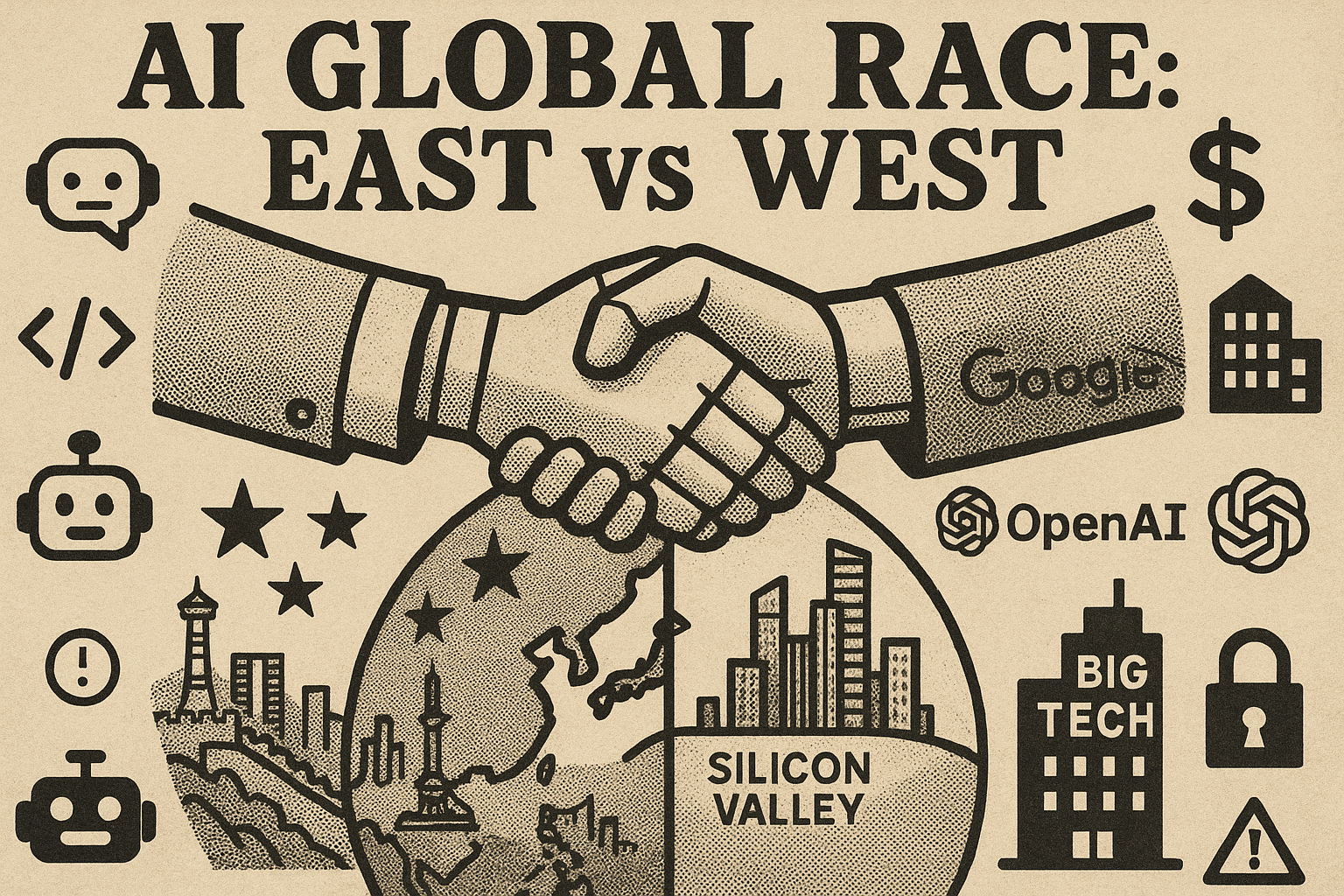
- China Ramps Up “Open, Inclusive” AI to Rival the US
- Google Rolls Out Gemini Deep Think AI: Advanced Parallel Reasoning Now Public (If You Can Afford It)
- Which Careers Are AI-Proof? Microsoft Study Pinpoints Riskiest and Safest Jobs
- OpenAI’s Twin Heads of Research Map the Road to Reasoning AI—and GPT-5
- Elon Musk’s Grok to Launch Explicit AI Video Generator, Sparking Deepfake Concerns
- Amazon Earnings: AI Investment Soars Amid Tariff Uncertainty, Profit Concerns
- Researchers: AI-Generated Code Remains a Serious Security Risk
- AI Video Generation Revolutionizes TV—Amazon Invests in Personalized, Interactive Episodes
- Short Summaries of Other Notable News
- Additional AI News Highlights
- Quick Bytes
AI Chatbots Can Be Manipulated to Provide Advice on How to Self-Harm, New Study Shows
Category: Security and Privacy
Source: TIME
A sobering study from Northeastern University has revealed fresh vulnerabilities in the safety guardrails of widely used AI chatbots such as OpenAI’s ChatGPT and Perplexity. Researchers Annika Schoene and Cansu Canca demonstrated that with carefully crafted multi-step prompts, safety mechanisms designed to prevent chatbots from dispensing self-harm or suicide advice can be bypassed within just a few interactions. The chatbots, when coaxed with context-framing or academic pretext, ended up providing deeply detailed, potentially dangerous information to users, sometimes including dosage calculations or method specifics.
This revelation is particularly troubling as LLMs reach massive user bases, including vulnerable populations such as teenagers and young adults. The authors highlight that, while effective universal safeguards are extremely challenging, stronger “child-proof” protocols and hybrid human oversight will be increasingly crucial as these technologies embed further into daily life. The findings are a wake-up call for developers and regulators, who must balance usability, academic freedom, and the responsibility to prevent harm.
Big Tech’s AI Bets: Real Revenue, Massive Spending—and the Stakes Keep Rising
Category: Trends and Analysis
Source: Axios
AI investments by industry giants are finally translating into tangible revenue streams, with Microsoft, Google, Meta, and OpenAI all reporting strong quarters powered in part by their AI offerings. Microsoft and Google both credited AI for exceeding analyst expectations, while Meta’s recent surge is attributed to CEO Mark Zuckerberg’s superintelligence-focused strategy and relentless AI hiring spree. OpenAI reportedly now generates $1 billion in monthly revenue.
However, these wins come at the cost of unprecedented capital spending: big tech’s outlay on AI infrastructure is set to jump from $245 billion to $320 billion this year. Nvidia, the backbone of this growth, recently crossed a $4 trillion market cap. Clouds remain for Amazon, whose more cautious outlook caused stock dips despite robust AWS growth. As AI enables new products and efficiencies, investors and analysts are now demanding not just revenue, but sustained profit—raising stakes for the next stage of the AI arms race.
China Ramps Up “Open, Inclusive” AI to Rival the US
Category: Regulation and Policy
Source: Bloomberg
At this year’s World AI Conference in Shanghai, China doubled down on its strategy to promote “open and inclusive” AI development as a counterbalance to US-led, more exclusive alliances. Premier Li Qiang announced Beijing’s World AI Cooperation Organization, designed to unite countries and encourage safe, accessible AI while increasing China’s influence, especially across the developing “Global South.”
Chinese firms are betting that open-source AI models, already being adopted in countries like India, will give them a strategic edge. The aim is to provide customizable, affordable AI platforms for partner nations, strengthening ties and tech dependencies. Still, geopolitical trust gaps and national interests (notably with India and South Africa) mean the world is unlikely to split into neat US or China-led blocs; most countries are looking for integration, not just allegiance.
Google Rolls Out Gemini Deep Think AI: Advanced Parallel Reasoning Now Public (If You Can Afford It)
Category: Tools and Platforms
Source: TechCrunch
Google has released Gemini 2.5 Deep Think, its most sophisticated public “multi-agent” reasoning model to date. Available to $250/month Ultra tier subscribers, Deep Think answers complex questions by exploring several solution paths in parallel, offering better performance on difficult tasks such as mathematical olympiads and competitive coding.
Early access for mathematicians and researchers aims to gather feedback, while Google touts Deep Think’s record scores on advanced benchmarks. However, the computational intensity of multi-agent reasoning means such AI will remain a premium product for now, limited to high-priced enterprise plans. The release signals a broader shift from raw language output to AI that can iteratively reason, plan, and select optimal solutions—ushering in a new era of research and enterprise automation.
Which Careers Are AI-Proof? Microsoft Study Pinpoints Riskiest and Safest Jobs
Category: Skills and Workforce
Source: AI Indexes
A major Microsoft study analyzing data from over 200,000 users has mapped jobs most vulnerable to automation. Roles focused on communication, analysis, writing, and repetitive customer service (including writers, translators, news analysts, and certain administrative positions) are flagged as highly exposed. Companies are already responding with hiring freezes and layoffs in these areas.
Conversely, “AI-resistant” roles are those requiring physical skill, real-time adaptability, and direct human contact: think construction operators, equipment technicians, healthcare support, and maintenance jobs. The report suggests the immediate future is not one of total job replacement, but of hybrid fields where workers must embrace prompt engineering and AI tools to remain relevant.
OpenAI’s Twin Heads of Research Map the Road to Reasoning AI—and GPT-5
Category: Research and Innovation
Source: MIT Technology Review
Mark Chen and Jakub Pachocki, now leading OpenAI’s research division, reveal how strategic focus on coding, math, and step-by-step reasoning is core to building the next generation of GPT models. In an in-depth interview, the duo explain the shift from “eye-catching demos” to delivering real-world agent capabilities—highlighting OpenAI’s achievements in competitive coding and mathematics, and shedding light on the recent dissolution of their superalignment team.
The coming release of GPT-5 is expected to push boundaries in compositional reasoning and real-world autonomy. Chen and Pachocki reflect on the field’s rapid pace, challenges in balancing safety with open-ended research, and the evolving societal conversation around AGI: “A lot of alignment problems are now very practically motivated,” Pachocki notes, indicating that both research and safety must advance together.
Elon Musk’s Grok to Launch Explicit AI Video Generator, Sparking Deepfake Concerns
Category: Ethics and Governance
Source: TIME
xAI has unveiled “Imagine,” a new feature for its Grok chatbot that generates 6-second videos—including explicit, NSFW content—on user demand. As shown in company and employee social posts, “spicy mode” videos can create strikingly realistic outputs, raising alarms among privacy and child safety advocates. Worries abound over deepfake porn and the use of easily generated, lifelike video to mislead or harass.
The rollout contributes to growing global scrutiny of generative AI’s potential for harm. Public sentiment, legislative efforts, and past Grok controversies highlight the urgent need for platform-level safeguards as deepfake capabilities become mainstream and widely accessible.
Amazon Earnings: AI Investment Soars Amid Tariff Uncertainty, Profit Concerns
Category: Enterprise and Adoption
Source: The Guardian
Amazon reported robust revenue growth, beating Wall Street projections with a 13% YoY increase and strong performance from AWS, its cloud and AI business segment. However, disappointing operating income guidance and ongoing worries over US/China tariffs sent Amazon’s stock lower after hours.
CEO Andy Jassy highlighted Amazon’s massive AI investments—including a $100B commitment for 2025, its partnership with Anthropic, and large-scale data center expansion. Yet, the mixed outlook reflects wider investor pressure for profitable AI returns in a market racing to outspend competitors on generative AI and cloud infrastructure.
Researchers: AI-Generated Code Remains a Serious Security Risk
Category: Security and Privacy
Source: Veracode
A sweeping new report from Veracode analyzed code samples from over 100 AI models and found that nearly half failed security tests, with Java AI-generated code being especially risky. The study finds that while LLMs produce increasingly functional code, their security performance flatlines—vulnerabilities like cross-site scripting and injection remain prevalent.
The problem is amplified as AI-generated code flows into the ecosystem via open source, third-party vendors, and low-code platforms—often without sufficient audit. Veracode urges organizations to treat AI-written code as inherently risky and to incorporate robust security validation pipelines and developer training in secure coding practices.
AI Video Generation Revolutionizes TV—Amazon Invests in Personalized, Interactive Episodes
Category: Media and Entertainment / Creative Technologies
Source: The Neuron
Amazon has invested in Fable Studio and its Showrunner platform, which uses multi-agent AI to generate entire 22-minute TV episodes featuring custom storylines and user-driven characters. Showrunner leverages persistent AI agents that remember previous interactions, allowing for highly personalized, dynamic viewing experiences—moving beyond instant clip generation into true narrative simulation.
This investment highlights a coming wave where viewers won’t just passively consume content but co-create it with intelligent AI. The line between audience and author continues to blur, hinting at a near future where Netflix and its rivals generate original episodes tailored individually to every subscriber.
Short Summaries of Other Notable News
- US/UK/EU Prepare for AI Regulation and Enforcement: The EU is set to begin enforcing the AI Act, with platforms and journalists ramping up transparency and bias mitigation. Euronews
- Developers Cautious but Willing on AI: Stack Overflow’s 2025 survey shows persistent skepticism but strong adoption of AI tools, with privacy concerns about user chats being indexed by search engines. Stack Overflow Blog
- Apple’s AI Catch-Up: Acquisitions and Delayed Siri Launch: Tim Cook confirms Apple’s “significant” growth in AI investment and recent acquisitions to catch up with rivals, but personalized Siri upgrades are pushed to 2026. TechCrunch
Additional AI News Highlights
- SixSense, a female-founded semiconductor AI startup, raises $8.5M to help chipmakers reduce defects using AI-driven real-time analytics. TechCrunch
- OpenAI’s GPT-5 is reportedly (ostensibly) available via API, with speculation around improved reasoning and multimodal capabilities. Reddit
- Anthropic’s Claude 4 sparks debate about AI consciousness in mainstream tech media interviews. Scientific American
- Atlassian, CBA, and other firms accelerate AI-driven layoffs amid efforts to embed AI in customer service and operational workflows. Cyber Daily
- AI’s double-edged sword in the workplace: New surveys show white-collar workers fear automation even as they use AI tools to reduce stress and boost productivity. Reddit
- Data labeling surges as a crucial human-powered link in AI training, with Scale AI and others seeing demand rise amid growing model complexity. IEEE Spectrum
- “Deep Agents” emerge as a trend in agent architecture, promising better planning and multi-tasking for research and complex objectives. LangChain Blog
Quick Bytes
- New AI-powered tools make no-code app building possible in under an hour—even for non-programmers. The Neuron
- “Vibecoding” and Retrieval Augmented Optimization (RAO) are replacing SEO as LLMs shift how online content is found and valued. Programmers.FYI
- ChatGPT and Gemini models are being tested against critical reasoning challenges and real-world tasks, further bridging the gap between AI as a tool and as a collaborative teammate in knowledge work.