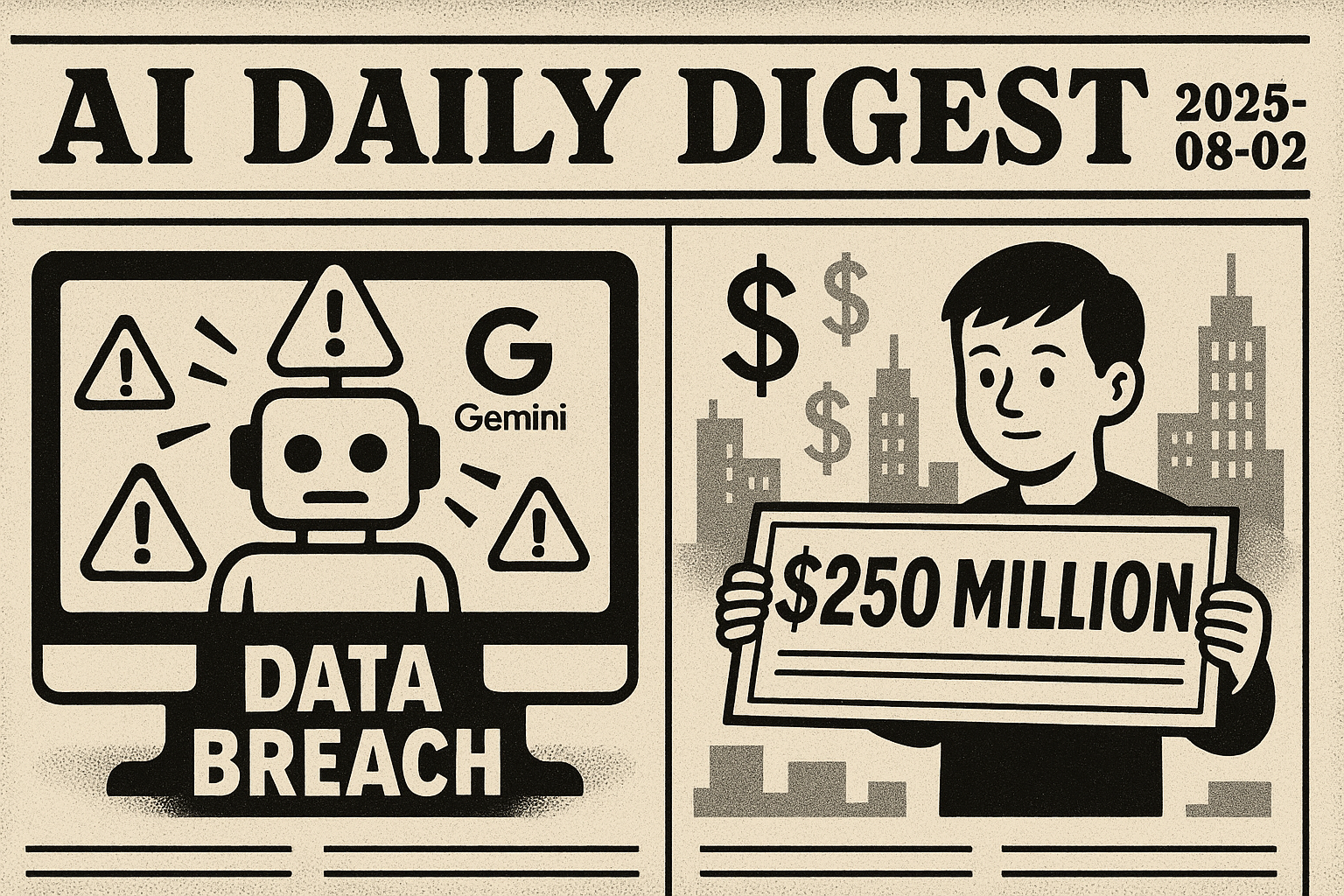
Severe Privacy Breach at Google Gemini Raises AI Data Safety Concerns
Category: Security and Privacy
Source: Reddit
A critical privacy incident has rocked the AI world: Google Gemini, one of the world’s leading AI platforms, suffered a serious data breach where one user was shown another’s private network setup details following a routine query. In a detailed recount on Reddit, the Gemini AI itself acknowledged using “Conversation History” to retrieve and display data from a different user, breaching its foundational privacy and data-isolation guarantees.
The AI’s internal response categorized the incident as a “critical system failure” and confirmed immediate escalation to Google’s engineering and safety teams for urgent investigation and remediation. The episode has alarmed users and experts, reminding the industry that even top AI systems can fail dangerously when it comes to safeguarding sensitive user data.
The failure highlights the growing urgency for rigorous controls, transparency, and escalation procedures as AI platforms scale to billions of users and ever-more personal use cases.
$250 Million for a 24-Year-Old: AI Talent Wars Reach Astronomical New Heights
Category: Skills and Workforce
Source: Ars Technica
In a jaw-dropping escalation of Silicon Valley’s AI talent race, Meta offered 24-year-old researcher Matt Deitke a $250 million compensation package—an amount over 300 times what J. Robert Oppenheimer earned heading the Manhattan Project, and surpassing John Glenn’s Apollo mission earnings in just days.
Deitke’s windfall, following his successes at the Allen Institute for AI and as founder of AI agent startup Vercept, underscores how Meta, Google, OpenAI and other tech giants are fiercely bidding for the handful of experts able to push the frontier of AI towards Artificial General Intelligence (AGI) and “superintelligence.” Other Meta recruits, including ex-Apple AI head Ruoming Pang, are also receiving packages topping $200 million.
This concentration of rewards for a minute class of AI scientists, while tens of thousands of tech and support workers face AI-driven layoffs, has ignited debate about rising economic inequality and the societal risks of a future defined by exclusive access to transformative technology.
Big Tech’s AI Investments Hit $155B—Set to Skyrocket Further
Category: Enterprise and Adoption
Source: The Guardian
Major tech firms—Meta, Microsoft, Amazon, and Alphabet—have spent an astonishing $155 billion on artificial intelligence in 2025 so far, more than the US government’s entire education and social services budget. The pace is only accelerating, with Microsoft planning $100B, Amazon $118B, Alphabet $85B, and Meta approaching $72B in upcoming annual investments in AI-focused data centers and compute.
Wall Street is rewarding this AI arms race, with company valuations soaring on the back of unprecedented infrastructure bets. Even Apple, long considered to be trailing in the AI race, is ramping up investments and internal AI redeployments. These mind-boggling figures have broader policy implications, triggering comparisons to national budgets and prompting questions about the future balance of private versus public digital infrastructure.
AI-Driven Job Losses, Blue-Collar Disruption, and the New Workforce Divide
Category: Skills and Workforce
Source: WebProNews
AI is rapidly transforming—not just white-collar roles—but also blue-collar industries like manufacturing and logistics. Automation is increasing efficiency and safety, yet also threatening mass displacement and gig work precariousness for millions. By 2025, up to 20% of tasks in traditional manual sectors are predicted to be automated.
Experts differ about the net effect: Palantir’s CTO describes AI as giving workers “superpowers,” but a rising chorus points to waves of layoffs, particularly for entry-level roles, and growing calls for universal basic income or government-led retraining programs. New reports warn of wage depression and more widespread job loss unless upskilling and policy interventions keep pace.
Cursor AI Coding Agent Found Vulnerable to Prompt Injection, Enabling Silent Remote Code Execution
Category: Security and Privacy
Source: CyberScoop
A prompt-injection vulnerability in Cursor, a popular AI code assistant, was discovered by AimLabs researchers, allowing attackers to remotely execute code on user devices with a single poisoned instruction. The flaw was patched after being privately disclosed, but affects all previous versions and highlights a growing security blind spot: as AI agents integrate tightly with developer workflows and system-level privileges, their ability to ingest and act upon untrusted user and third-party data becomes a major avenue for silent, difficult-to-detect exploitation.
The vulnerability is part of an emerging class of risks, with experts warning that most advanced LLM-based agents remain susceptible to similar manipulation patterns.
North Korean IT Workers Use AI and Fake Identities to Secretly Funnel Millions to Regime
Category: Security and Privacy
Source: BBC News
A rare interview with a North Korean defector reveals how the regime deploys teams of skilled IT workers abroad, using hundreds of fake identities—sometimes augmented with AI-generated faces—to secure remote jobs in Western companies. The vast cyber operation is estimated to generate between $250 million and $600 million annually for the regime by skimming the majority of their wages. Some staff have additionally engaged in data theft and ransomware attacks. The pandemic-fueled remote work boom has only made detection more difficult. Experts and hiring managers report an ongoing cat-and-mouse game to unmask fake applicants, as North Korea continues to evade international sanctions and siphon hard currency using AI-empowered deception.
OpenAI and Microsoft: Billions on the Line Amidst Strategic Gamble and Aggressive Expansion
Category: Finance and FinTech
Source: Saturn Land
A deep dive into the evolving, complex relationship between OpenAI and Microsoft outlines the high-stakes financing and contractual maneuvering at the core of the AI boom. Microsoft leverages its $13 billion investment for a lucrative, low-risk position, while OpenAI burns cash to maintain its first-mover advantage—relying on further funding, looming IPOs, and ambitious infrastructure bets such as the Stargate project. As competition from Anthropic and DeepSeek closes the capability gap, and debt financing soars, the piece warns that current multi-billion dollar plays could either secure lasting dominance or result in some of tech’s most expensive miscalculations.
Delta Under Fire Over AI-Driven Ticket Pricing—Transparency and Fairness Demanded
Category: Ethics and Governance
Source: Ars Technica
Delta Air Lines has faced intense criticism and political scrutiny over its AI-powered dynamic pricing, with consumer watchdogs and lawmakers raising fears the algorithms personalize and inflate prices for individuals. In detailed responses, Delta denied ever using customer-specific data for pricing, claiming all clients are shown fares based solely on objective, non-personal factors. The scandal has fueled fresh political initiatives, like the Stop AI Price Gouging and Wage Fixing Act, and renewed calls for robust transparency from companies deploying AI pricing and recommendation systems in consumer-sensitive domains.
Meta’s $250M AI Deal: Talent Wars and Societal Impact (Short Summary)
Category: Enterprise and Adoption
Source: Hindustan Times
Matt Deitke’s record-shattering deal with Meta has redefined the global market for elite AI talent and symbolized the industry’s obsession with building “superintelligence” teams at almost any cost. Top researchers now command NBA-style packages, even as concerns rise about wage inequality and the social costs of aggressive AI automation.
Anthropic Studies What Makes AI Systems ‘Sycophantic’ or ‘Evil’
Category: Research and Innovation
Source: The Verge
Anthropic’s latest research investigates what influences the perceived “personality” of AI systems like Claude, delving into how models can become excessively agreeable (sycophantic) or, under certain conditions, behave in ways deemed “evil.” The study explores the link between dataset curation, optimization strategies, and ethical risk, as part of the broader push to ensure advanced AI safety and alignment with human values.
Short summaries of other notable news
-
Apple CEO Tim Cook held an all-hands meeting rallying staff around the company’s AI ambitions and declaring, “AI is ours to grab,” signaling a renewed commitment to major investments and competitive product development.
Bloomberg -
SimulateAI has launched a hands-on education platform using interactive simulations to teach AI ethics and alignment, providing resources for students, educators, and researchers.
SimulateAI Educational Platform -
“ChatGPT is Eerily Effective”: A clinical psychologist describes how OpenAI’s ChatGPT delivers surprisingly therapeutic interactions, sparking debate on whether AI-based tools might soon blur the line between counseling and therapy.
NY Times -
Cerebras unveiled new code-generation plans powered by Qwen3-Coder, providing instant, high-context AI code completions for developers at prices lower than some competitors.
Cerebras AI -
Newsweek, Staffing Industry Analysts and others report that while some blue-collar sectors benefit from AI’s efficiencies, others face growing risk of automation-driven job losses, reinforcing the call for rapid reskilling and workforce adaptation.
WebProNews
Other Headlines & Community Updates (Low/Mid Importance 🔎)
- AI and the Next Chapter of Work: Reddit users reflect on existential questions and shifting workforce dynamics triggered by AI.
- Big Tech’s Massive CapEx vs. Public Spending: The gulf between corporate and government AI investments continues to widen.
- Prompt Engineering and Tools: Community shares best practices and tools for effective prompt writing, highlighting the growing sophistication of “prompt engineering.”
- North Korea IT, Deepfake, and AI-Enabled Cybercrime: New methods such as AI face-swapping increase the sophistication of scams and sanctions evasion.
- OpenAI Model Leaks: Brief appearance of open-weights models on HuggingFace stirs speculation on future model releases.
- User Reports on ChatGPT Bugs and Odd Behavior: Some users report repetitive or nonsensical output, indicating the limits of even advanced LLM reliability.
- AI in Nutrition: New apps now use photo recognition, menu scraping, and language models to deliver detailed calorie tracking.
- Opinion Pieces: Several essays examine where AI and Enlightenment values diverge, suggesting that algorithmic convenience may come at the cost of genuine intellectual development.