Table of contents
Open Table of contents
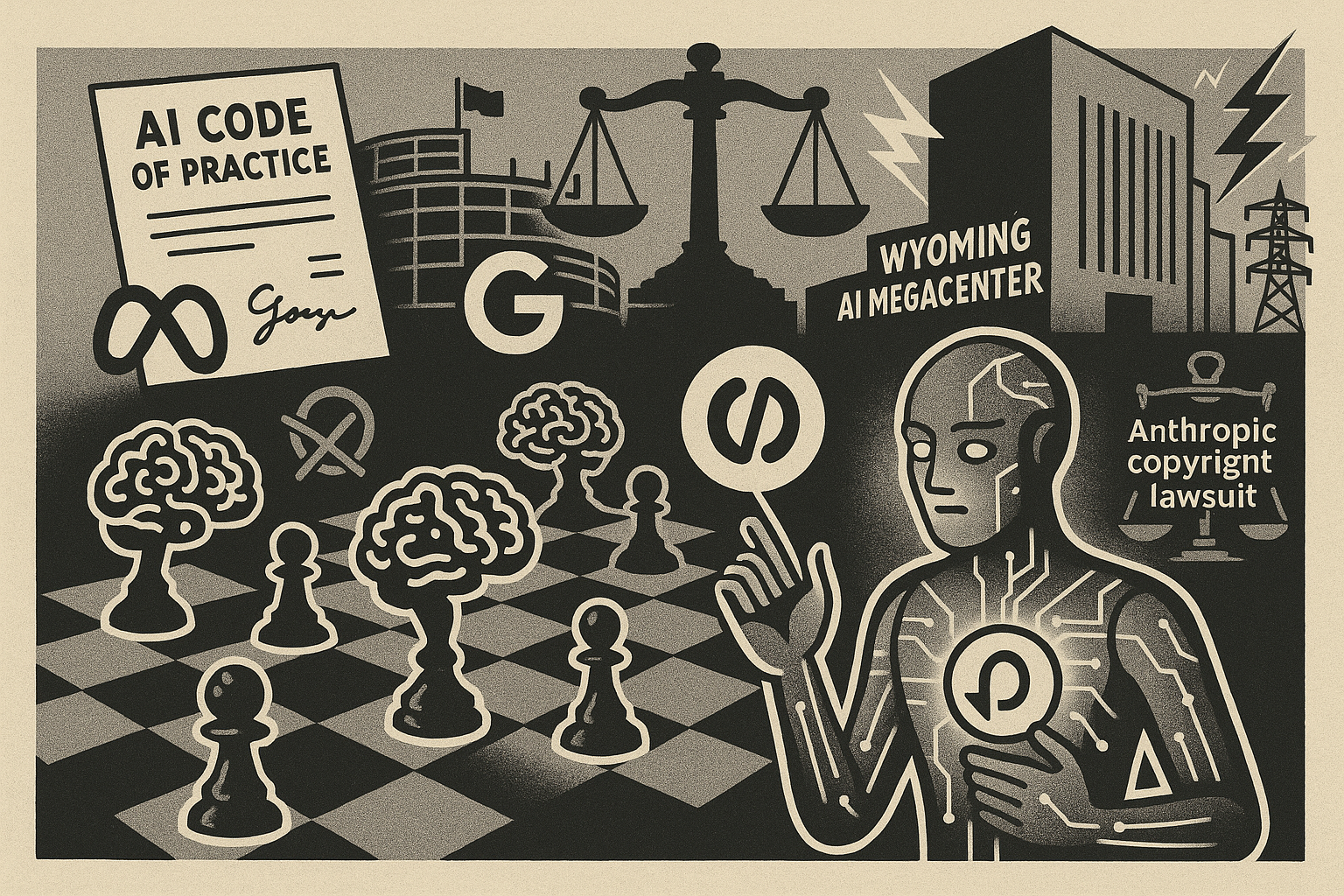
- Anthropic Seeks $170B Valuation Amid Copyright Battles That Could Reshape AI Industry
- Meta Pivots: “Personal Superintelligence” Vision and Pause on Open Sourcing Advanced AI
- Europe Raises the Bar: Google Signs EU AI Code of Practice, Meta Declines
- Wyoming’s Mega Data Center: AI Power Demand to Eclipse Entire State’s Consumption
- Delta’s AI-Driven Fare Pricing Sparks Regulatory and Consumer Backlash
- Carnegie Mellon / Anthropic: LLMs Can Autonomously Plan and Execute Sophisticated Cyberattacks
- Stack Overflow & Veracode: “Almost Right” AI Code and Widespread Security Flaws
- Deep Agents and Planning: The Next Leap for AI Automation
- Other Notable Developments
- Short Summaries
- Other Short News & Updates
Anthropic Seeks $170B Valuation Amid Copyright Battles That Could Reshape AI Industry
Category: Startups, Regulation and Policy, Legal
Sources: The Verge, Crunchbase News, Obsolete.pub
Anthropic, the creator of the Claude family of AI models and a leading OpenAI rival, is reportedly raising $5 billion at a dramatic $170 billion valuation led by Iconiq Capital. This deep-pocketed push places Anthropic alongside the very top AI players, yet the optimism is shadowed by immense legal risk. A class action over training data could expose Anthropic to penalties “that could bankrupt it — and reshape the entire industry.” Authors allege that millions of pirated books were used to train models, with potential statutory damages running into the billions. The ruling in this case may set precedent for how all generative AI companies deal with copyrighted content, with significant spillover effects for Meta, OpenAI, and Google. As the AI gold rush continues, the outcome of these lawsuits could dictate not just the financial but also the ethical foundation of future AI giants.
Meta Pivots: “Personal Superintelligence” Vision and Pause on Open Sourcing Advanced AI
Category: Corporate Strategy, AI Research, Ethics
Sources: TechCrunch, Wired, Fortune, The Decoder
Mark Zuckerberg and Meta made waves this week. While announcing strong quarterly results, Zuckerberg set out a vision to bring “personal superintelligence” to billions, focusing on empowering individuals rather than automating all human work. Meta’s AI research lab is now focused on self-improving models, with Zuckerberg admitting that the latest generation is “beginning to show signs of improving themselves.” Notably, he signaled that future, more powerful AI may not be open sourced due to safety concerns—a major strategic shift after years of promoting openness with models like Llama. This move arrives as Meta invests billions in compute and talent, escalating an AI arms race that is fundamentally reshaping both technology and business models.
Europe Raises the Bar: Google Signs EU AI Code of Practice, Meta Declines
Category: Regulation and Policy
Sources: CNBC, Google Blog, Ars Technica, The Guardian
The European Union’s landmark AI Act moves closer to implementation, as Google formally agrees to sign the new General Purpose AI Code of Practice. The code provides guidance on how to comply with the strict requirements of the AI Act, covering transparency, copyright, and safety obligations. While Google views this as a path to fostering innovation in Europe, it warns that some conditions could slow progress. In stark contrast, Meta rebuffed the code, claiming it could “stunt” AI development and innovation. The EU’s approach—complemented by tough age-verification and safety checks—sets a global bar for AI governance that even the largest tech companies must reckon with or risk regulatory action and fines.
Wyoming’s Mega Data Center: AI Power Demand to Eclipse Entire State’s Consumption
Category: Infrastructure and Hardware
Sources: Ars Technica, AP News, Tom’s Hardware, Seeking Alpha
Cheyenne, Wyoming is set to become the site of one of the most power-hungry AI data centers on earth. The proposed facility, a joint project between Tallgrass and Crusoe, could draw up to 10 gigawatts of power—five times more than all homes in the state combined. This development signals a new era of large-scale AI infrastructure, raising questions about energy sustainability, resource allocation, and the environmental impact of the AI boom. Local leaders tout economic benefits, but critics warn about power grid stress and ecological consequences as AI drives a global scramble for datacenter capacity.
Delta’s AI-Driven Fare Pricing Sparks Regulatory and Consumer Backlash
Category: Regulation and Policy / Ethics
Sources: GetJetBack Blog
In a first for a major U.S. airline, Delta is deploying AI-powered pricing that sets ticket costs based on individual customer profiles. While airlines defend this strategy as smart business and potential profit booster, consumer advocates and lawmakers argue it borders on predatory “surveillance pricing.” The move has triggered a political and regulatory debate, as the line blurs between revenue optimization and personal data exploitation at the heart of the AI-driven economy.
Carnegie Mellon / Anthropic: LLMs Can Autonomously Plan and Execute Sophisticated Cyberattacks
Category: Security and Privacy
Source: Cybersecurity Dive
Researchers from Carnegie Mellon University and Anthropic have shown that large language models (LLMs) can autonomously plan and perform complex cyberattacks with little or no human input, including the ability to replicate high-profile breaches like Equifax. Their toolkit, Incalmo, allows LLMs to exploit, install malware, and exfiltrate sensitive data. The findings raise critical alarms about the growing potential for AI-driven cyber threats and spotlight the urgent need for automated defenses that can operate at “machine timescale” to keep up with next-generation attackers.
Stack Overflow & Veracode: “Almost Right” AI Code and Widespread Security Flaws
Category: Security and Privacy, Enterprise and Adoption
Sources: VentureBeat, Veracode
New reports confirm a worrying trend: as AI-generated code is widely adopted by professional developers, security vulnerabilities and technical debt are mounting. Stack Overflow’s survey shows that while 84% of developers use AI tools, only 33% trust their output—citing “almost right but not quite” solutions that require time-consuming fixes. Veracode’s security study found that 45% of AI-generated code failed critical security tests, and new AI models are not showing improvement. The implication for organizations is clear: fast AI-driven development without robust security practices is a costly and risky gamble.
Deep Agents and Planning: The Next Leap for AI Automation
Category: Tools and Platforms / AI Research
Sources: LangChain Blog
A new generation of “deep agents” is emerging, capable of robust long-horizon planning and complex, multi-phase problem solving. With blueprints inspired by offerings like Claude Code and Deep Research, these agents use specialized prompts, sub-agents, planning tools, and file systems to operate more autonomously and deliver higher-quality results across research and coding. This marks a substantial leap beyond naive looping architectures and hints at the coming wave of domain-specific AI automation for enterprises and individuals alike.
Other Notable Developments
- EU AI Regulation Tightens Grip on Industry: The EU’s AI Act, with its stringent requirements and voluntary code of practice, is reshaping the regulatory landscape for global AI companies. Google has signed on, but Meta has balked, citing risks to competitiveness.
- Massive AI Layoffs and Labor Disruption: TCS, Atlassian, and banks in the UK are laying off thousands as AI is aggressively adopted to streamline operations, causing ripples of anxiety about job security in white-collar sectors globally.
- Apple Loses AI Talent, Meta and Anthropic Lead Talent Wars: Apple has lost multiple top AI researchers in one month to Meta, underlining the ferocious competition for elite expertise as companies race to lead the superintelligence era.
- Microsoft Study and Workplace Automation: A Microsoft survey identifies the 40 jobs most susceptible to AI replacement, highlighting the profound impact of automation on employment, particularly in roles focused on information processing and communication.
- Environmental Impact of AI & Data Centers: AI data centers are now outstripping residential power usage in entire states, and research draws attention to huge water and energy demands that may strain local communities.
- Security Flaw in “Vibe Coding” Platforms (Base44/Wix): A major vulnerability discovered by Wiz Research allowed unauthorized access to private enterprise apps on the Base44 platform, spotlights the importance of authentication and robust security in no/low-code and agentic development environments.
- ChatGPT and AI Education: OpenAI’s new “study mode” in ChatGPT shifts from rote answers to step-by-step tutoring, as AI literacy becomes a core focus in schools around the world.
- Meta, Google, and Vendor Strategies Diverge on Open Source vs. Closed AI: Meta signals caution on open sourcing its most powerful models, while others tout openness but struggle with trade secrets and competitive risks.
Short Summaries
- Novel AI Architectures: A new 27M-parameter hierarchical AI model can reason 100x faster than larger LLMs, challenging the “bigger is better” dogma (The Neuron).
- EU’s Ambitious AI “Gigafactory” Plan: Europe announces major investments in AI “gigafactories” to boost compute capability by 15% and achieve technology sovereignty (CNBC).
- AI in Market Research: AI-powered simulated societies now replace traditional surveys for faster, deeper, and cheaper market research (a16z).
- Critical API Key Exposure: An analysis shows how careless sharing in AI platforms like ChatGPT, Perplexity, and Hugging Face allows Google searches to reveal thousands of private API keys (Medium).
- AI in Fashion Under Fire: Widespread backlash erupts after Vogue and Guess feature AI-generated “perfect” models, sparking debate about diversity and beauty standards (ABC, MalayMail, The Independent).
- UK Copyright Battle: The Starmer government faces criticism for letting US tech giants scrape UK creative works for AI, raising existential questions about intellectual property in the AI age (PeakD).
- PlayerZero Raises $15M for AI-Powered Bug Detection: Startups are racing to build tools that automatically identify and fix AI-generated bugs in code before they reach production (TechCrunch).
- Lucidic, Hyprnote, and Crush: New tools launch to enhance interpretation, debugging, privacy, and productivity for professional developers, illustrating the explosion of agentic and open source developer ecosystems.
Other Short News & Updates
- Nvidia’s data center revenue has increased 10x over two years, fueled by booming demand for AI chips.
- Google DeepMind launches AlphaEarth: an AI model operating as a “virtual satellite” for planet-scale environmental analysis.
- YouTube implements AI age verification for US users, in line with global regulatory trends.
- Meta’s AI superintelligence team lures talent from Apple and OpenAI with massive pay packages, intensifying the AI talent wars.
- Atlassian cuts 150 staff by pre-recorded video, citing AI-driven automation of customer support roles.
- “Deep agent” architectures and modular prompt engineering are now enabling powerful new AI workflows for code, research, and creative tasks.
- Microsoft Copilot adds a friendly avatar presence for chat, evoking nostalgia for Clippy and hinting at evolving, more personalized user experiences.
- Public debate and case law deepen around AI authorship, copyright, and the legality of model training datasets globally.