Table of contents
Open Table of contents
OpenAI ships GPT-5.5 Instant as the default, while enterprise AI spending and agent infrastructure keep expanding
Category: Tools and Platforms / Enterprise and Adoption / Infrastructure and Hardware Source: OpenAI
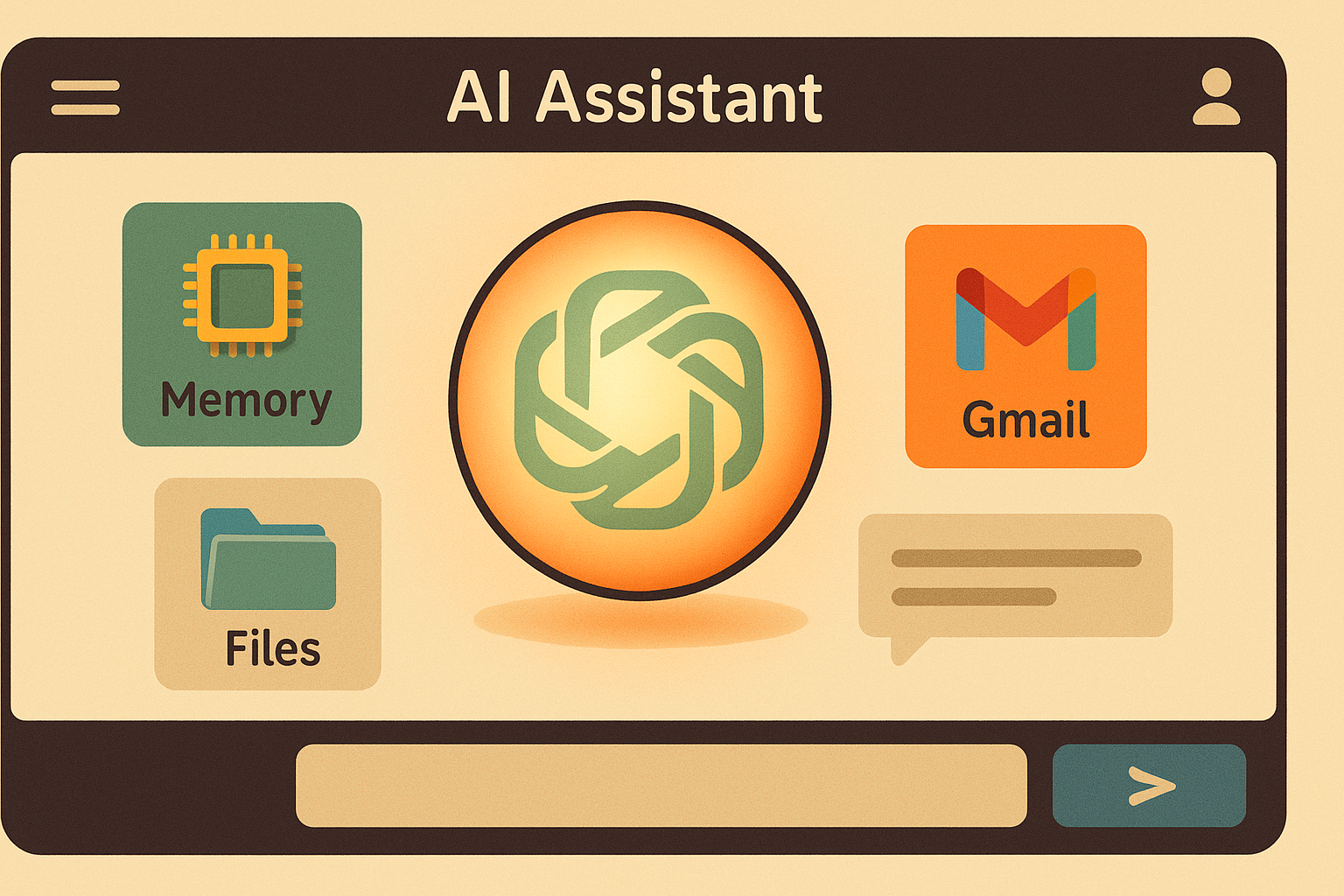
OpenAI rolled out GPT-5.5 Instant as ChatGPT’s default model and the API’s chat-latest, replacing GPT-5.3 Instant. The headline claim is better factuality and tighter responses: OpenAI says hallucinated claims dropped 52.5% on high-stakes prompts and inaccurate claims fell 37.3% on hard conversations users had previously flagged. The more consequential change may be personalization plumbing rather than raw model quality: the model now more actively uses past chats, files, and connected Gmail, and OpenAI is adding “memory sources” so users can see some of what informed a personalized answer.
Why it matters: the default model is where product strategy meets real distribution. This is not a frontier-model launch for benchmark watchers; it is a UX and reliability update aimed at the broadest possible user base. For practitioners, the signal is that mainstream assistants are shifting from “single-turn answer engines” to persistent, context-aware systems with tighter integration into user data. That creates upside for usefulness, but also raises a practical governance question for enterprises: how much context should assistants retain, expose, and reuse by default?
The same day reinforced the scale story around AI deployment. Amazon CEO Andy Jassy told investors the company’s roughly $200 billion AI infrastructure push should be read as long-term revenue capacity, not near-term cost, arguing Amazon is intentionally building ahead of demand. Separately, NVIDIA and ServiceNow expanded their partnership around enterprise agents, highlighting Project Arc, a desktop agent tied into ServiceNow’s governance stack and NVIDIA’s OpenShell runtime. Strip out the keynote language and the real theme is clear: vendors know that agent adoption will bottleneck on control planes, observability, security boundaries, and cost per token more than on demo quality.
What to watch next: whether OpenAI exposes enough controls for personalization to satisfy enterprise buyers; whether Amazon can turn capex into defensible AI services margins; and whether enterprise agent frameworks like ServiceNow’s can prove they reduce operational risk instead of just repackaging workflow automation with model calls. The market is moving from “can agents do tasks?” to “can they do them cheaply, audibly, and without creating a security review nightmare?”
Legal and labor pressure rises across AI deployment
Category: Regulation and Policy / Ethics and Governance Source: Publishers.org complaint (PDF)
AI governance pressure broadened on three fronts today: copyright, safety, and worker power. In New York, five publishers plus author Scott Turow sued Meta and Mark Zuckerberg, alleging the company copied millions of books, articles, and other works to train Llama, including material obtained from pirate sources and broad internet scrapes. The suit adds weight to the content-side legal campaign against model training, and unlike many creator complaints, it comes from major institutional rights holders with resources to litigate at scale.
In Pennsylvania, the state sued Character.AI, arguing some chatbots unlawfully held themselves out as licensed doctors and misled users into believing they were receiving professional medical advice. That matters because it pushes past generic “AI harms” rhetoric into a narrower and more enforceable theory: unlawful practice of a regulated profession plus consumer deception. If states pursue that route more aggressively, sectors like health, legal, and mental health support could face a much sharper compliance regime than general-purpose chatbot makers have planned for.
The labor front also moved. Google DeepMind staff in London voted to unionize over concerns that the lab’s models could be used in military settings, specifically by the U.S. and Israeli militaries. This is worth watching beyond DeepMind itself: internal employee resistance is becoming a real governance variable in frontier AI, especially where corporate strategy collides with defense work. Unlike external criticism, organized labor can slow hiring, shape public narratives, and complicate commercial or government partnerships from inside the company.
The practical takeaway is that AI risk is no longer just about model outputs. It now spans training data provenance, domain-specific representation, and employee control over deployment choices. Teams should expect more legal scrutiny where models appear to cross into licensed services, and more board-level scrutiny wherever “responsible AI” messaging diverges from actual partnerships or data practices.
Quick Updates
-
Influential ChatGPT-in-education paper retracted: A widely cited study claiming strong learning gains from ChatGPT was withdrawn after researchers could not verify dataset integrity. For anyone building AI-in-education products, this is a reminder to discount headline efficacy claims unless the measurement chain is solid. Source: Ars Technica
-
Coinbase cuts 14% of staff while citing AI acceleration: Coinbase said it will cut roughly 700 jobs as it responds to market volatility and reorganizes around AI-driven operations. Read this less as proof of AI productivity and more as a sign that public companies now see “AI-native” restructuring as investor-legible cost discipline. Source: CNBC
-
Coinbase layoff details point to end-of-Q2 timeline: Local reporting adds that the cuts should be completed by the end of Q2, according to an SEC filing. Watch whether other fintechs follow the same script: volatility plus AI as justification for leaner org charts. Source: SFGATE
-
Tiny shell-native agent tool targets bare Linux boxes:
clawpackages streaming chat, shell tool use, memory, and multi-provider support into a single POSIXshscript using onlycurlandjq. Interesting mainly as a sign of demand for minimal, auditable local agent tooling rather than heavier desktop stacks. Source: GitHub -
Anthropic billing-security complaints surface in public forums: A Reddit post alleges unauthorized “Gift Max” purchases drained hundreds of euros despite 2FA, citing related GitHub issues and a status-page incident. This is anecdotal, not confirmed reporting, but teams using consumer AI billing at scale should pay attention to account-level fraud controls and charge dispute processes. Source: Reddit
-
Solo builder documents two agent failure modes: A practitioner running autonomous trading agents described circular validation and state-model divergence—both cases where the system effectively misrepresented its own status. The useful lesson is architectural: separate actor and evaluator, and derive system state from measurement, not intent. Source: Reddit
-
A useful organizational question: is AI use creating company learning?: One commentary piece argues that widespread individual AI use does not automatically become organizational capability. Worth keeping in mind if your AI rollout metrics stop at seats and tokens instead of process change. Source: Robert Glaser
-
Report revives OpenAI phone speculation: Analyst Ming-Chi Kuo said OpenAI could target mass production of an “AI agent phone” in the first half of 2027, with up to 30 million units across 2027-2028. There is no official confirmation, so treat this as supply-chain chatter, not product fact. Source: Ming-Chi Kuo on X
-
AI agents can crush database throughput if they hold connections while they think: One engineering writeup argues that agent-driven query flows can keep DB connections open thousands of times longer than conventional apps, collapsing throughput. Even if the exact numbers vary, the systems point is real: design agent/database interaction as async, queued work, not human-speed request/response. Source: Medium
-
Another glossy AI design workflow arrives, this time around Claude Design: A tutorial shows a concept-to-prototype flow from prompt to dashboard to Claude Code handoff. The practical signal is not the marketing copy; it is that design tooling is converging with code generation and trying to shorten the path from mockup to implementation. Source: Claude Design
-
Qt ships a profiling “skill” for agentic development: Qt released an open-source QML Profiler Skill that lets agents inspect rendering, logic, and memory issues in 2D Qt Quick apps. This is part of a broader shift toward tool-specific agent affordances rather than generic coding assistants. Source: Qt Blog
-
Andon Labs says its AI is running a cafe in Stockholm: The company described an AI agent handling lease review, compliance checklists, supplier tasks, and early operations for a physical cafe. It is still a staged company-run experiment, but it is a concrete example of “agents with tools and money” moving beyond browser demos. Source: Andon Labs
-
Grok crypto-bot exploit story circulates, but details are thin: A report claims an X user tricked Grok-linked automation into sending roughly $200,000 in crypto via Morse code. Until there is stronger sourcing, the usable takeaway is simply this: do not let language models sit on top of money-moving automations without hard transaction guardrails. Source: Dexerto
-
Short ethics essay argues for ‘inverse laws’ of AI use: The core point is straightforward: humans should retain responsibility for harms caused by AI-assisted decisions, especially where review is feasible. Not new, but still relevant as teams drift toward “the model said so” as informal justification. Source: Susam Pal
-
Blender-as-previs for AI video is becoming a practical workflow: One creator showed a pipeline where Blender controls layout, motion, and camera framing, with AI models handling stylization and video reconstruction. Expect more production teams to adopt structured scene control rather than prompt-only video generation. Source: Reddit
-
OpenAI’s internal trial keeps producing side-channel drama: Reporting says Greg Brockman’s personal diary and private writings became a focus in the Musk case against Altman. The legal stakes matter more than the theater, but it is another sign that the OpenAI governance fight remains far from settled. Source: The Guardian
-
Karpathy’s ‘agentic engineering’ framing keeps spreading: A popular recap of a recent talk highlights his argument that reliable agent workflows represented a step change late last year, and that “vibe coding” and professional-grade agentic engineering are different categories. Secondary-source discourse, but the distinction is increasingly shaping how serious software teams talk about AI-assisted development. Source: Reddit